
Brand Strategy
Must-See Brand Checklist Before Starting a New Brand in the USA
The short answer
It covers the practical pieces I would want you to think through before launch, from legal and financial setup to branding, pricing, technology, team structure, marketing and organic growth.
Starting a brand in the USA is exciting right up until you realise how many decisions sit between “I have an idea” and “I’m ready to take my first customer’s money.”
Your name needs checking. Your business structure needs deciding. Your finances need separating. Your website needs more than a pretty homepage. Your pricing needs to leave room for actual profit. Your marketing needs a plan before you start spending on ads. And somewhere in the middle of all this, you need to decide what your brand actually stands for.
As the founder of a marketing agency, I’ve seen this from both sides. Founders rarely struggle because they have too few ideas. They struggle because they try to build everything at once, often starting with a logo or Instagram page before figuring out the business underneath it.
So, if you are starting a new brand in the USA, use this as your pre-launch checklist.
It covers the practical pieces I would want you to think through before launch, from legal and financial setup to branding, pricing, technology, team structure, marketing and organic growth.
Important: Business registration, tax, licensing, employment and intellectual-property requirements can vary by state, city, industry and business structure. This guide is a practical planning checklist, not legal or tax advice. Verify requirements for your specific situation with the relevant US authorities and qualified professionals.
What you will learn
- Key insights: What should you have ready before launching a new brand in the USA?
- What should you figure out about the business before worrying about the brand?
- Which legal structure and registrations do you need to sort out?
- Have you checked your brand name before falling in love with it?
- What should you secure once your brand name is selected?
Key insights: What should you have ready before launching a new brand in the USA?
If you want the short version, don't launch until you can answer these questions clearly:
| Area | What should you have decided? |
|---|---|
| Business | What are you selling, to whom and why will they buy it? |
| Legal | What business structure will you use and where will you operate? |
| Name & IP | Is your proposed name available and have you checked for conflicting trademarks? |
| Finance | What will it cost to launch, what will it cost to operate monthly and when do you expect to break even? |
| Banking | How will you separate business money from personal money? |
| Brand | What do you stand for, who are you for and how should you sound? |
| Offer | What exactly are customers buying and what does it cost? |
| Pricing | Does your price cover your costs, acquisition expenses and desired margin? |
| Website | Can someone understand, trust and buy from you without speaking to you? |
| Technology | Do you have the essential tools for payments, email, analytics, customer management and security? |
| Marketing | How will your first customers discover you? |
| Organic growth | What will you publish, optimise and build consistently before relying on paid traffic? |
| Team | What actually needs to be done by an employee, and what can stay founder-led or outsourced? |
| Launch | What needs to happen before, during and immediately after launch? |
The US Small Business Administration's launch guidance similarly puts business structure, registration, tax IDs, licences and permits, banking and insurance among the core launch considerations.
Now let's unpack what that means in practice.
What should you figure out about the business before worrying about the brand?
Before colours, fonts, packaging or social media, answer the commercial questions.
Your basic business brief
- What are you selling?
- Who exactly is buying it?
- What problem does it solve?
- Why does that problem matter?
- What alternatives do customers already have?
- Why should someone choose you instead?
- Will you sell locally, nationally or across multiple states?
- Will you sell online, in-store, through marketplaces, through distributors or through a combination?
- What will your first product or service be?
- What will you not offer at launch?
That last question is surprisingly important.
A new brand does not need twenty products, twelve services and every possible marketing channel on day one. You need a clear enough offer that someone can understand what you do and decide whether it is relevant to them.
The SBA recommends market research and competitive analysis as part of business planning because understanding customers and competitors helps you identify an opportunity and competitive advantage.
Your first founder worksheet
| Question | Your answer |
|---|---|
| Customer | Who are you building this for? |
| Problem | What are they struggling with? |
| Solution | What are you offering? |
| Difference | Why you rather than an alternative? |
| Market | Where will you sell? |
| Revenue | How will the business make money? |
| First offer | What will you launch first? |
| Proof | Why should someone trust you? |
If these answers keep changing, your brand strategy is not ready yet.
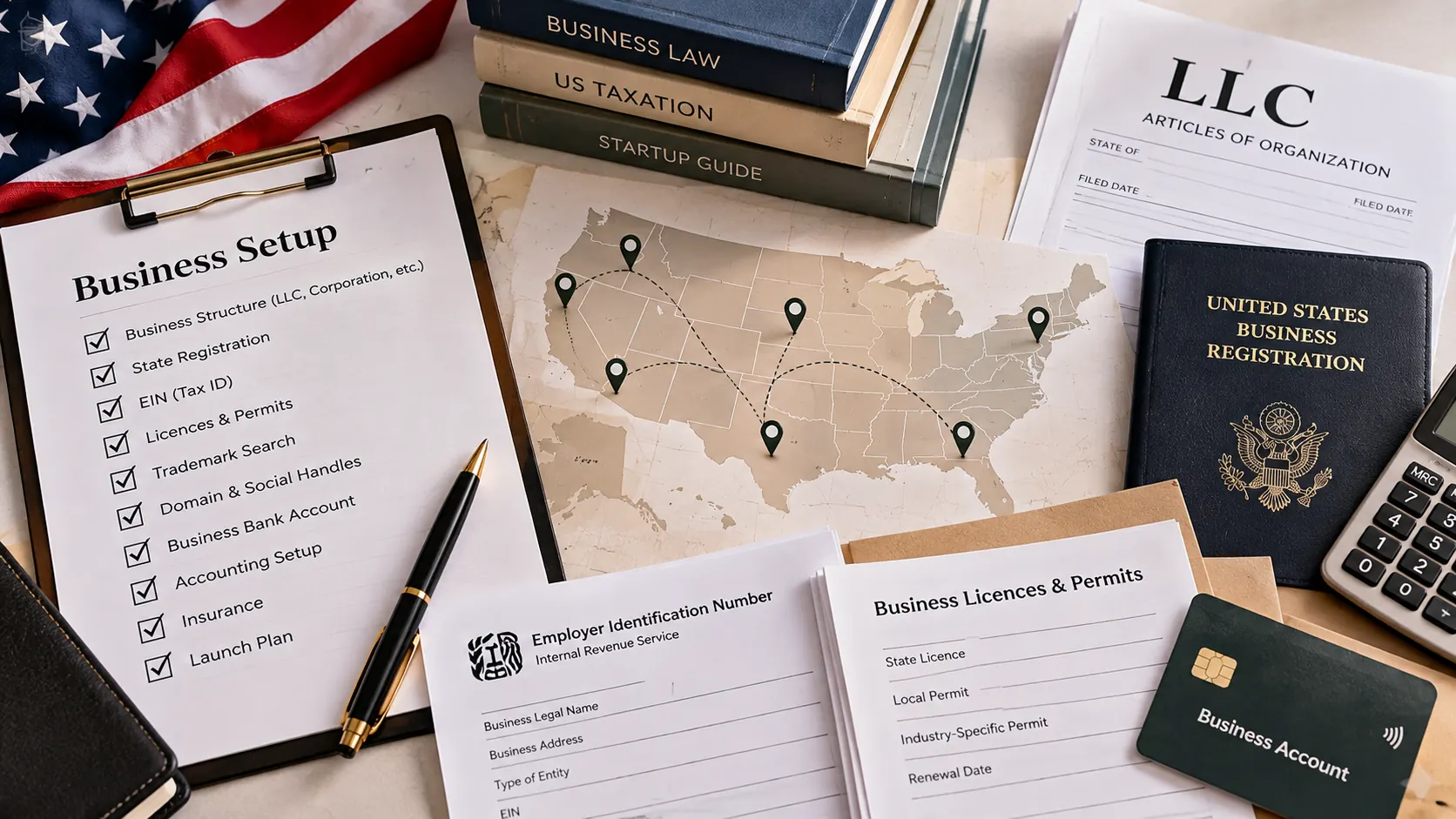
Which legal structure and registrations do you need to sort out?
Your business structure affects taxation, liability, paperwork and how the business can operate, so this is one of the decisions to make before you start treating the brand as a fully operational business. The SBA notes that structure should be selected before registration and that requirements differ according to location and business type.
Depending on your circumstances, you may need to consider:
- Sole proprietorship
- Partnership
- LLC
- Corporation
- DBA or trade name
- State registration
- Local registration
- Federal and state tax IDs
- Industry-specific licences
- Local permits
- Registered agent requirements
- Business insurance
- Ongoing state filings
Do not assume that forming an LLC automatically covers every requirement. The SBA states that licences and permits depend on your business activity and location, with requirements potentially applying at federal, state, county and city level.
A simple rule
Decide where you are operating → determine your structure → check registration requirements → check licences and permits → then build the operational setup around it.
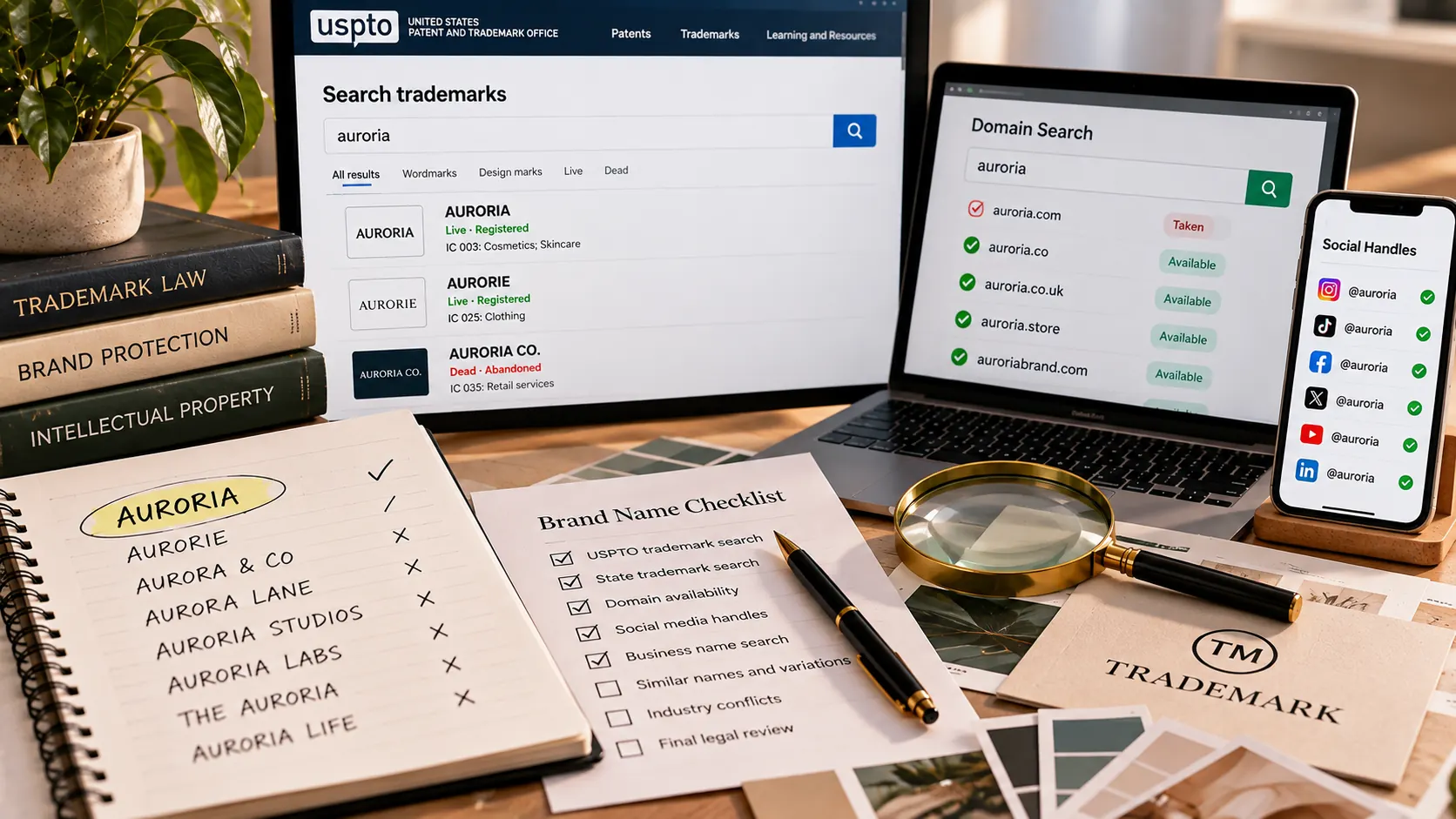
Have you checked your brand name before falling in love with it?
Please do this before paying for packaging, signage, a website redesign or thousands of dollars of creative work.
A domain being available does not mean your brand name is legally available.
The USPTO recommends conducting a trademark clearance search before applying for federal registration, including looking for confusingly similar marks. Its guidance also notes that a comprehensive search can involve federal and state databases as well as internet searches.
Your name checklist should include:
- Business name search
- USPTO trademark search
- State trademark/business records
- Google search
- Domain availability
- Social handle availability
- Marketplace searches
- Competitor research
- Relevant industry terminology
And don't check only the exact spelling.
Look for names that sound similar, look similar or create a similar commercial impression, particularly where the goods or services overlap.
If the name is important to your long-term business, a qualified trademark professional can help with a more comprehensive clearance assessment.
What should you secure once your brand name is selected?
Once you have a name you can reasonably move forward with, secure the digital real estate.
Your basic brand ownership checklist
☐ Domain name ☐ Relevant domain variations, where useful ☐ Primary social handles ☐ Business email domain ☐ Google Business Profile, if applicable ☐ Marketplace usernames, if relevant ☐ Brand files and original creative assets ☐ Password manager access ☐ Centralised ownership records
Your domain should not be treated as an afterthought. The SBA specifically recommends registering your domain when establishing an online presence and notes that your domain does not necessarily have to exactly match your legal business name, trademark or DBA.
What should your brand actually stand for?
This is where branding begins, rather than where logo design begins.
Before asking a designer to “make it look premium”, establish:
- Your brand purpose
- Mission
- Vision
- Values
- Target audience
- Positioning
- Value proposition
- USP
- Brand personality
- Brand promise
- Core messages
- Tone of voice
You don't need a 60-page brand book.
You do need enough strategic clarity that your website, packaging, social media, advertising and customer service don't all sound like five different businesses.
At Draft Rooom, this is the thinking we build into our brand strategy and messaging services, covering areas such as positioning, audience profiles, value propositions, messaging frameworks, brand voice, brand story and naming.
What should be included in your visual brand identity?
Once the strategy is clear, your visual system can have a job to do.
At minimum, consider:
| Brand asset | What it should establish |
|---|---|
| Logo | Recognition |
| Colour palette | Visual consistency and emotional association |
| Typography | Personality and readability |
| Photography style | Visual character |
| Graphic elements | Recognition beyond the logo |
| Iconography | Consistent supporting visuals |
| Packaging direction | Physical brand experience |
| Social templates | Consistent publishing |
| Brand guidelines | Rules for using everything correctly |
Your style guide should be usable, not something that sits in a folder nobody opens.
Include examples of what to do, what to avoid, how the logo works, how colours are used, which fonts belong where and how the brand should look across real-world applications.
How should you decide what your first product or service should be?
Don't confuse having lots of ideas with having a strong launch range.
For a new brand, ask:
- What is the clearest problem we can solve?
- Which product or service is easiest to explain?
- Which offer has the strongest commercial potential?
- What can we deliver consistently?
- What creates a natural next purchase?
- What can we realistically support operationally?
For products, also consider:
- Manufacturing
- Minimum order quantities
- Packaging
- Storage
- Shipping
- Returns
- Damaged stock
- Supplier lead times
- Product compliance
- Inventory cash flow
For services, consider:
- Scope
- Delivery time
- Capacity
- Revision limits
- Client communication
- Payment terms
- Contractor support
- Recurring vs project revenue
The goal isn't to launch everything. It is to launch something you can deliver well.
How much should you budget before launching?
This is where many founders underestimate what “starting a brand” actually costs.
Your startup budget should separate one-time costs from recurring costs.
One-time costs may include
- Business formation
- Professional advice
- Trademark work
- Branding
- Website development
- Photography
- Packaging design
- Initial inventory
- Equipment
- Initial software setup
- Launch creative
Recurring costs may include
- Payroll or contractors
- Rent
- Software subscriptions
- Hosting
- Insurance
- Accounting
- Inventory replenishment
- Fulfilment
- Marketing
- Advertising
- Payment processing
- Customer support
The SBA recommends calculating startup costs before launch and separating one-time and monthly expenses so you can understand your funding needs and estimate when the business may reach break-even.
Your minimum financial model
| Number | Why it matters |
|---|---|
| Startup cost | How much you need to get moving |
| Monthly fixed costs | What you owe regardless of sales |
| Variable cost per sale | What increases with every customer |
| Average selling price | Your typical revenue per transaction |
| Gross margin | What remains after direct costs |
| Customer acquisition cost | What it costs to acquire a customer |
| Break-even sales | How many sales you need to cover costs |
| Cash runway | How long your available cash can support operations |
Do not choose your price by looking at what a competitor charges and subtracting $5.
We'll come to pricing.
What should you set up for your business banking and payments?
Your business money should have a clear home.
Depending on your structure and circumstances, you may need:
- Business checking account
- Business savings account
- Business credit card
- Payment processor
- Merchant account or payment service
- Accounting system
- Expense management process
- Invoicing system
- Payroll account/process, if hiring
- Sales tax tracking where applicable
The SBA recommends opening a business bank account when you're ready to start accepting or spending business money and notes that banks commonly ask for items such as an EIN, formation documents, ownership agreements and business licences.
The IRS also notes that an EIN may be needed for various business purposes, including hiring employees, operating as certain business structures, opening a business bank account and applying for business licences or credit.
Keep this separation clean
Personal money → personal account
Business revenue → business account
Business expenses → business account
That separation makes accounting, reporting and financial decision-making considerably easier.
How should you price your new brand's products or services?
Pricing deserves its own strategy.
Start with the numbers, not the competitor's website.
For a product brand
Think about:
Selling price − product cost − packaging − fulfilment − payment fees − shipping contribution − returns/allowances − acquisition cost = contribution
For a service business
Think about:
Selling price − delivery cost − contractor/employee cost − software − sales cost − overhead allocation = contribution
Then ask:
- Is the margin sustainable?
- Can you afford customer acquisition?
- What happens if costs rise?
- Can you offer discounts without destroying margin?
- Does your price match your positioning?
- Is there a logical entry-level offer?
- Can the customer understand what they receive?
Your price is part of your positioning.
A premium-looking website with bargain-basement pricing can create one message. A cheap-looking website with premium pricing creates another.
Your entire customer experience should make the price make sense.
Which website pages should a new brand have before launch?
Your website doesn't need 40 pages on day one.
It needs the right pages.
A basic brand website might need
- Homepage
- About
- Product/service pages
- Contact
- FAQ
- Privacy policy
- Terms and conditions
- Shipping/returns information, where applicable
- Relevant legal or regulatory disclosures
- Blog/resources, if content is part of the growth strategy
Your homepage should quickly answer:
What do you offer, who is it for, why should I care and what should I do next?
And your product/service pages should remove friction rather than simply describe features.
If you need help turning your positioning into a website that actually communicates and converts, Draft Rooom also offers website and landing page content alongside conversion copy and content strategy.
What should you set up for website security and business email?
This is easy to ignore until something goes wrong.
Before launch, check:
☐ HTTPS/TLS ☐ Business email on your own domain ☐ SPF ☐ DKIM ☐ DMARC ☐ Multi-factor authentication ☐ Password manager ☐ Admin access records ☐ Regular software updates ☐ Website backups ☐ Analytics access ☐ Domain renewal reminders
The FTC recommends security-conscious hosting and specifically highlights TLS and email authentication technologies including SPF, DKIM and DMARC for businesses using domain-based email.
Also decide who owns the accounts.
Your website, domain, analytics, advertising accounts and social profiles should not accidentally belong to a freelancer's personal email address.
Which software and tools does a new brand actually need?
You don't need 47 subscriptions because a YouTuber recommended them.
Start with a lean stack.
| Business need | What you need |
|---|---|
| Professional business email | |
| Finance | Accounting/bookkeeping system |
| Payments | Payment processor |
| Website | CMS/storefront + hosting |
| Analytics | Website analytics |
| Customer data | CRM or customer database |
| Communication | Team/email communication tool |
| Project management | Task and workflow system |
| Creative | Design/content creation tools |
| Storage | Secure cloud storage |
| Passwords | Password manager |
| Marketing | Email/SMS platform where appropriate |
| Customer support | Shared inbox/helpdesk where needed |
| Automation | Automation platform when repetitive work appears |
| Reporting | Dashboard/reporting system |
Your rule should be:
Don't buy software because you might need it. Buy it because you have a recurring problem it solves.
Start lean. Add complexity when the business earns the complexity.
How many employees do you actually need at launch?
Probably fewer than you think.
Your first question shouldn't be:
“How many people should I hire?”
It should be:
“What work must happen every week for this business to function?”
Map the jobs:
Product/service delivery → sales → marketing → customer support → finance → operations → fulfilment
Then decide which responsibilities belong to:
- Founder
- Employee
- Contractor
- Specialist agency
- Software/automation
A lean launch team could look like this
| Function | Possible early setup |
|---|---|
| Strategy & decisions | Founder |
| Sales | Founder + sales support |
| Marketing | Founder + specialist/agency |
| Content | Specialist/agency |
| Finance | Accountant/bookkeeper |
| Design | Freelancer/agency |
| Customer support | Founder initially, then dedicated support |
| Operations | Founder or operations support |
| Fulfilment | Internal or third-party provider |
There is no universal “correct” employee count.
And be careful with worker classification. The IRS says businesses must correctly determine whether someone is an employee or an independent contractor, because the tax and reporting responsibilities differ.
What should your first 90-day marketing plan look like?
Do not start by opening every social account and boosting random posts.
Start with discovery.
Month 1: Build the foundation
- Brand positioning
- Website
- Search fundamentals
- Social profiles
- Foundational content
- Analytics
- Email capture
- Customer research
- Initial creative assets
Month 2: Start distribution
- SEO content
- Social publishing
- Email list building
- Partnerships
- Founder-led content
- Community participation
- Reviews/testimonials where legitimately available
- Small paid tests, if appropriate
Month 3: Learn and optimise
- Identify high-performing content
- Improve landing pages
- Analyse acquisition channels
- Refine messaging
- Build more of what customers respond to
- Remove activities producing little value
This is where an integrated SEO, AEO and GEO content strategy can become useful. You don't just want pages that contain keywords. You want useful information structured around the questions your prospective customers actually ask.
How should you approach organic growth before spending heavily on ads?
Organic growth isn't “post on Instagram and hope.”
Think about your owned discovery system.

Your organic growth engine
Search demand ↓ Useful content ↓ Website experience ↓ Email capture ↓ Trust/proof ↓ Conversion ↓ Repeat purchase/referral
Your content can include:
- Educational articles
- Comparison pages
- Product/service explainers
- Founder stories
- Customer questions
- Tutorials
- Case studies
- FAQs
- Industry insights
- Original research
- Short-form social content
- Email content
The objective isn't to publish because “we need three blogs this week”.
It is to create assets that answer questions before the customer has to ask you.
What should your SEO foundation include before launch?
At minimum, make sure you have:
☐ Search-friendly site structure ☐ Clear page titles ☐ Useful meta descriptions ☐ Descriptive headings ☐ Search-intent-led content ☐ Internal links ☐ Indexable pages ☐ XML sitemap ☐ Canonicalisation where needed ☐ Structured data where appropriate ☐ Fast, usable pages ☐ Mobile-friendly experience ☐ Search analytics setup ☐ Conversion tracking
For a new brand, SEO should begin with what people are searching for and why, not with a spreadsheet containing 5,000 keywords.
Draft Rooom's SEO, AEO and GEO work includes keyword research and mapping, search-intent analysis, on-page SEO, structure optimisation and internal linking.
What should you prepare before your first advertising campaign?
Paid marketing works much better when the business underneath it is ready.
Before spending, check:
☐ Clear offer ☐ Clear landing page ☐ Defined target audience ☐ Conversion tracking ☐ Creative variations ☐ Tested messaging ☐ Budget ceiling ☐ Customer acquisition target ☐ Follow-up process ☐ Someone responsible for leads/orders
And remember: advertising claims need to be truthful and supported by appropriate evidence. The FTC states that advertising must not be deceptive or unfair and that advertisers need evidence for claims they make.
That becomes particularly important if your brand operates in categories involving health, finance, children's products, safety or other regulated claims.
What should you prepare for email marketing from day one?
You don't need a massive email programme at launch.
But you should have somewhere to build your audience.
Consider:
- Branded email address
- Email platform
- Signup mechanism
- Welcome sequence
- Transactional emails
- Promotional emails
- Customer segmentation
- Unsubscribe process
- Basic reporting
If you're sending commercial email in the US, CAN-SPAM requirements matter. The FTC says commercial emails need accurate sender information, non-deceptive subject lines, a valid postal address and a clear way for recipients to opt out, among other requirements.
That means “we'll figure out email later” is not a great launch strategy.
What should you prepare for customer trust before asking people to buy?
A new brand starts with a disadvantage: nobody knows you yet.
You need to replace familiarity with evidence.
Depending on your business, that could mean:
- Founder story
- Product demonstrations
- Transparent pricing
- Clear policies
- Reviews
- Testimonials
- Case studies
- Certifications
- Credentials
- Expert commentary
- Media coverage
- User-generated content
- Behind-the-scenes content
- Guarantees, where genuinely offered
Don't manufacture proof.
Build it.
And don't use testimonials or advertising claims casually. The FTC has specific requirements around endorsements, reviews and advertising claims.
How should you plan your brand's first content?
Don't start with:
“What should we post today?”
Start with:
“What does our customer need to know before they trust us enough to buy?”
Build your first content around five buckets:
| Content type | Purpose |
|---|---|
| Problem | Shows you understand the customer |
| Education | Helps them make a better decision |
| Product/service | Explains what you offer |
| Proof | Reduces perceived risk |
| Founder/brand | Makes the business human |
That gives you far more substance than filling a calendar with motivational quotes and product graphics.
What should your brand's style guide say about communication?
A verbal style guide should answer:
How do you sound when you're selling?
How do you sound when you're helping?
How do you sound when something goes wrong?
Define:
- Voice
- Tone
- Vocabulary
- Sentence style
- Words to use
- Words to avoid
- Product naming conventions
- Capitalisation
- Punctuation
- Customer terminology
- CTA style
- Examples of good copy
- Examples of off-brand copy
This becomes particularly valuable once someone other than the founder starts writing.
What should you measure from the beginning?
You don't need 100 KPIs.
Track the numbers that help you make decisions.
Commercial
- Revenue
- Gross margin
- Average order value
- Customer acquisition cost
- Customer lifetime value
- Repeat purchase rate
- Conversion rate
Marketing
- Organic traffic
- Search impressions
- Leads
- Email subscribers
- Email revenue
- Paid traffic
- Cost per acquisition
- Landing-page conversion rate
Customer
- Reviews
- Refunds/returns
- Support volume
- Repeat purchases
- Customer complaints
- Referral activity
A dashboard should help you decide what to do next. If it only gives you numbers to look at, simplify it.
What should your complete pre-launch checklist look like?
Here's the version I'd actually save.

🧾 Business & legal
- Business model defined
- Target market selected
- Business structure decided
- Business registered where required
- EIN/tax IDs handled where applicable
- Licences and permits checked
- Insurance reviewed
- Relevant contracts prepared
- Trademark/name search completed
💰 Finance
- Startup costs calculated
- Monthly operating costs calculated
- Pricing model created
- Break-even point estimated
- Cash runway understood
- Business bank account established
- Payment processing selected
- Accounting system established
🏷️ Brand
- Name selected
- Domain secured
- Social handles secured
- Positioning defined
- Target audience defined
- USP/value proposition defined
- Brand voice established
- Visual identity created
- Style guidelines documented
💻 Digital
- Website built
- Business email established
- Analytics installed
- Search tools connected
- Security configured
- Backups established
- Password management organised
- Key accounts have correct ownership
📣 Marketing
- Launch message created
- Content plan prepared
- Social profiles ready
- Email capture active
- Welcome sequence ready
- SEO foundation established
- Organic growth plan established
- Paid media plan created, if applicable
- Customer acquisition process documented
👥 People
- Founder responsibilities defined
- Critical roles identified
- Employee/contractor decisions made
- Payroll process established if hiring
- External specialists identified
- Approval responsibilities assigned
🚀 Launch
- Customer journey tested
- Checkout/contact forms tested
- Mobile experience checked
- Policies visible
- Emails tested
- Analytics tested
- Customer support process ready
- Launch date confirmed
- First 30-day plan prepared
What should you not spend money on before your brand has proven demand?
This is my founder-to-founder section.
You can burn through a surprising amount of money making a business look established before it has established anything.
Be careful about spending heavily on:
- A huge office
- A giant initial inventory order
- Dozens of software subscriptions
- Elaborate packaging before testing demand
- A massive website nobody needs yet
- Hundreds of social templates
- Expensive advertising before tracking is ready
- A large team before you understand the workload
- Rebranding every few months
- Vanity PR with no clear business objective
Your first version does not need to look like a Fortune 500 company.
It needs to work.
How can Draft Rooom help you build the brand properly?
You already have enough on your plate when you're starting a brand. You shouldn't also have to become your own strategist, copywriter, SEO specialist, social media manager, website writer and marketing consultant.
At Draft Rooom, we work with founders who have the idea, the ambition and often a pretty good sense of what they want to build, but need help turning all of that into a brand people can actually understand and connect with.
That can start with getting the fundamentals right: your positioning, audience, value proposition, messaging, brand voice and narrative. Once those pieces are clear, they can shape everything else you put in front of your customers, from your website and content to your campaigns and social media.
Depending on where your business is right now, that might mean helping you with:
- Brand strategy and messaging
- Website and landing-page content
- SEO, AEO and GEO content
- Copywriting and conversion copy
- Content marketing
- Social media content
- Email and lifecycle marketing
- AI-led content and communication
The important thing is that these shouldn't feel like separate pieces of work. Your website should sound like the same brand people see on Instagram. Your ads should make the same promise as your website. Your content should reinforce what you want the brand to be known for.
That's how we approach marketing at Draft Rooom. We don't believe you need to buy every service at once just because you're launching a brand. We'd rather understand what you're trying to build, where you're getting stuck and what will actually move the business forward, then build the right support around that.
Sometimes that starts with the brand itself. Sometimes the strategy is already there and the website needs work. Sometimes you have a good brand but nobody is finding it. And sometimes people are finding you, but something in the customer journey isn't quite working.
You don't need a bigger marketing machine just for the sake of having one. You need the right pieces working together for the business you're building.
The real checklist is simpler than it looks
Starting a brand can feel like you're supposed to have everything figured out before you begin. You don't. You need enough clarity to make the next correct decision.
Know what you're selling. Know who you're selling it to. Make sure the business is set up properly. Protect the name you're building. Keep your finances clean. Give the brand a clear position and voice. Build the minimum technology you actually need. Price for sustainability. Create a way for people to discover you. Then launch, learn and improve.
The strongest new brands aren't necessarily the ones that started with the biggest budget.
They're the ones that knew what they were building before they started spending money to make it look like a brand.
Questions people ask
Must-See Brand Checklist Before Starting a New Brand in the USA: frequently asked questions
The questions readers ask most about brand strategy, answered in plain English. Anything else, send it through the form on this page.
Do I need an LLC to start a brand in the USA?
Not necessarily. The appropriate structure depends on your circumstances, location, ownership and business activities. The SBA explains that businesses can operate under different structures, each with different tax, liability and administrative implications.
Do I need an EIN before launching my brand?
It depends on your business structure and activities. The IRS says an EIN may be required for businesses that hire employees, operate as corporations or partnerships, file certain federal tax returns, or for other specified situations. Some banks and licensing processes may also require one.
Can I use a brand name that is different from my legal business name?
Potentially, yes. A business may operate under a DBA or trade name where permitted, but requirements vary by state and locality. A different business or trademark may also have rights that affect whether you can use your proposed brand name.
Should I trademark my brand name before launching?
You should at least investigate the trademark position before investing heavily in the brand. The USPTO recommends searching for similar trademarks before filing and explains that broader clearance searches can include federal, state and internet sources.
Do I need a business bank account for a new brand?
If you are operating as a business, keeping business finances separate is a sensible part of your financial setup. The SBA recommends opening a business bank account when you're ready to accept or spend business money and outlines common documentation banks may request.
How many employees should a new brand hire?
There is no fixed number. Start by mapping the work required to operate and grow the business, then determine which responsibilities need employees and which can be handled by founders, contractors, specialists or software. If you hire people, make sure their worker classification is correct under applicable rules.
How much money do I need to start a brand in the USA?
There isn't one useful universal figure. Your requirement depends heavily on your industry, inventory, location, team, technology, marketing model and operating costs. The SBA recommends calculating both one-time startup costs and ongoing monthly expenses before launch.
Do I need a website before launching my brand?
Not every business needs the same website at launch, but if your customers discover, research or purchase from you online, your website is an important part of the customer journey. At minimum, make sure visitors can understand your offer, assess your credibility and take the appropriate next step.
Can I start marketing before my brand officially launches?
Yes. Building awareness, an audience, an email list, educational content and relationships can all happen before launch. The important distinction is between building demand and making claims about a product or service you cannot substantiate.
Do US advertising rules apply to a small new brand?
Yes. The FTC states that advertising claims must be truthful, non-deceptive and supported by appropriate evidence, while additional requirements can apply to specific industries and types of claims.
About the author

Monika Singh
Founder and Content Strategist · Works globally, based in India
Monika Singh is the founder of The DRAFT ROOOM, a global brand and content marketing agency built on a simple belief: most brands do not have a marketing problem, they have a clarity problem. Fix what a brand says and why it says it, and everything downstream starts working harder.
She has spent her career on the writing side of growth, moving from product pages and campaign copy into brand positioning, messaging frameworks and full content programmes. That route matters. She learned what converts before she learned what sounds strategic, so the strategy she writes now always has to survive contact with a real product page, a real inbox and a real buyer.
Her work spans online wine and beverage retail, functional drinks, marketplaces and large product catalogues, healthcare and wellness, cafes and hospitality, professional services, SaaS and B2B. Common threads run through all of it: research first, human editing always, and content structured so that both search engines and AI assistants can quote it accurately.
Areas of expertise
- Brand strategy and positioning
- Brand voice and messaging frameworks
- Content marketing strategy
- SEO, AEO and GEO content
- Conversion and homepage copywriting
Credentials
- Founder of The DRAFT ROOOM, a global brand and content marketing agency
- Built long form product content frameworks used across catalogues of hundreds of products
- Led brand voice and messaging framework projects for multi market brands
- Designed email lifecycle programmes for e-commerce and subscription businesses
Keep reading

Brand Strategy
What Is Brand Strategy? The Complete Guide for Growing Businesses in 2026
8 minute read

Copywriting
How To Write Product Specifications That Customers Understand
16 minute read
Content Strategy
How To Build A Podcast Content Strategy From Scratch
16 minute read

AI Search
SEO vs AEO vs GEO: What's The Difference And How Should You Write For Each?
13 minute read
Let's build a brand your audience remembers.
Tell us what you are trying to grow. We will show you exactly how we would shape your brand and create the content to get there. No jargon, no pressure, just a clear plan and a straight answer.